Book reviewed by Chris J Kenworthy, for Armadillo magazine.
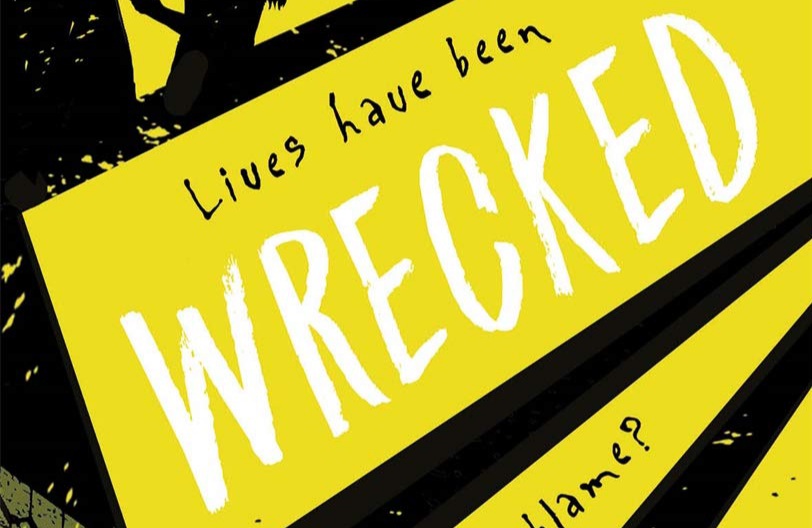
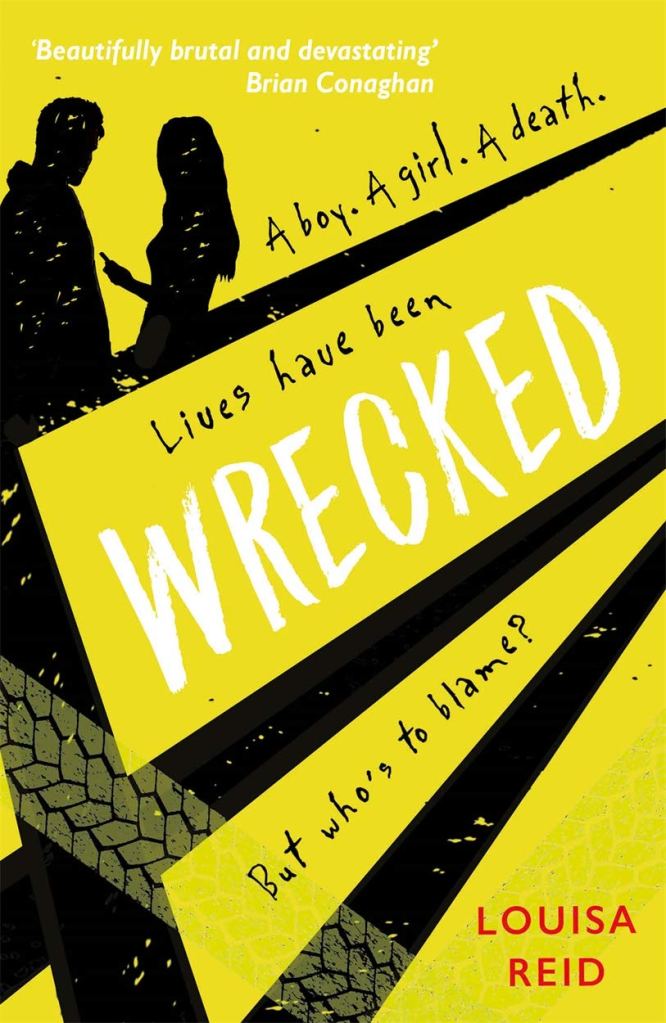
‘Wrecked,’ by Louisa Reid, is a story of a tumultuous teenage romance, seen through a series of memories & flashbacks that are interwoven with a court case following death by dangerous driving.
Whilst this is a story about morals, it is not moralistic, and cleverly uses spacing to convey the meaning of words on its pages. Whilst structured like a poem, it reads like a series of thoughts grouped into mini-chapters, with occasional rhyming.
At the start of the novel, the language in Joseph’s first-person narrative appears rather disjointed, and comes across as a series of disorganised thoughts, written in the style of bullet-points, which accurately captures Joe’s sense of guilt. This later gives way to more detailed flashbacks that question the behaviour of both Joseph, and his girlfriend Imogen, but never without losing the story’s poetic structure.
‘Wrecked’ is so innocent in its appearance, and yet devastating in its delivery, and the plot’s many twists & turns will have you questioning the narrator’s reliability (much like Nick’s unreliable narration in F. Scott Fitzgerald’s ‘The Great Gatsby,’ referenced in the novel).
Such is Joseph’s confusion, mixed with his desperation to gain empathy from both the members of the jury and the reader, that, occasionally, hidden messages appear within the main body of the text. Individual letters emboldened within different words, eventually group together to form phrases such as ‘Coward’ and ‘Not Guilty.’ It’s as if Joseph is continually questioning his own feelings and motives, much like the jury does during the court case which lasts the length of the book.
Is Joseph a normal teen, who’s been involved in a terrible car accident with his girlfriend Imogen, or is he guilty of manslaughter through reckless driving?
While some of the story’s vivid imagery may not be suitable for all readers, ‘Wrecked’ is a modern masterpiece that involves the reader emotionally, through the court case, to explore the wider issues of relationships, of truth, and the implications of ‘doing the right thing.’

 Stowmarket Reporter